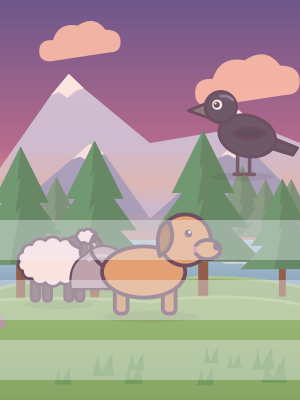
Bracken Keeps the Hill: the full story
One · Snow
The storm arrived over Hallam Hill on the last night of March, a full month after anyone had wanted it. By midnight the snow lay level with the top of the wall. Bracken, who was twelve years old and had patrolled this hill since before the new gate was hung, lay on the kitchen rug with his chin on his paws. He felt the weather in his hips first, a slow, stiff ache that told him somebody would have to go out in it.
Mrs. Hallam came downstairs in her coat and boots, with the lantern already lit. She did not call him, because she never had to. Bracken rose the way he rose now, back legs first and one at a time, and followed her out into the whirling white. The wind snatched the door out of her hand. Somewhere up the slope, behind the wall, a very small voice was complaining bitterly about the situation.
The voice belonged to a lamb no bigger than a loaf of bread, lying in a drift where her mother had nudged her aside. The ewe was standing over two other lambs, and she had milk enough for two, and the hill does not argue with that sum. Bracken lowered his head and lifted the little creature in his mouth, as delicately as he had once carried eggs for Mrs. Hallam's hens. She weighed almost nothing, and she was colder than the snow.
All night the lamb lay in a cardboard box beside the stove, with the oven door left open and a towel wrapped around her that smelled of lavender. Mrs. Hallam rubbed her with a rough cloth and talked to her, the way she talked to everything. Bracken lay down so close that the lamb's nose touched his ribs. Toward morning the nose twitched, and a moment later she pushed herself into his side, hard, as if to announce that she had made a decision.
"A rusty smudge on her face," said Mrs. Hallam at breakfast, holding the bottle. "Like a dock leaf in October. We will call her Sorrel." Sorrel drank, and hiccuped, and surveyed the kitchen as though she were considering buying it. Bracken, who had not slept at all, thumped his tail on the floorboards exactly once.
Two · Spring
By May, Sorrel could outrun the cat, and she had developed a passion for questions. Why did the wall climb the hill instead of crossing it? Why did Bracken always walk on the left? Why was the grass in the Soft Place greener than anywhere else, and why must nobody eat it? Bracken answered whatever he could. When he did not know, he said so. "The hill has always done it," he would tell her, "and I have never found out why."
"Never found out why!" cried Rook, who had been listening from the gatepost for some time. Rook was a crow, and he knew everything that happened on three hills and half of a fourth. He began most sentences with "I am not one to talk," and then talked for ten minutes. "A lamb with questions," he said. "That is a dangerous combination. I once knew a lamb with questions. Well. I heard of one."
So Bracken began to teach her the paths. They walked the entire hill that spring, with Sorrel half a step ahead and Bracken half a step behind. The brightest green grass was the bog, which would hold a lamb to the knees and keep her. The Long Scar looked solid and was not, because the loose stones went down in a small roar. "How do you know?" asked Sorrel. Bracken considered. "Because I have been wrong once on every one of them," he said.
One day a thought came to Bracken that he had been trying to keep out. A lamb learns the hill from her mother. The ewes carry the whole shape of the pasture in their heads, where the shelter is, and where the ground fails, and they hand it down. Sorrel had no mother to hand it down. She had a dog. It was not the same, and it was what she had. Then Sorrel asked about the bog again, and he forgot to feel it.
The Top Gate had a treacherous hinge. It swung shut on its own, with great force, and anyone who stood directly in front of it was knocked flat. Sorrel was knocked flat three times before she thought to ask Bracken why. "Because you were in the way," he said. "Stand beside it. Let it go past." The fourth time, Sorrel stood beside it, and the gate swung through with a clang and hit nothing at all, and she felt that she had always known.
Three · Summer
In July, Bracken stopped halfway up the Long Scar and stood perfectly still with his nose to the ground, as if he had found something worth smelling. There was nothing there, and his hips were burning. Sorrel, who had been about to ask what he was smelling, looked at him for a moment and said nothing, which she had never managed before. Then she put her own nose down. "Very interesting," she said, and they stood together for a considerable time.
That summer the flock grew accustomed to her. She marched at the front of the lambs and introduced them to the Soft Place, the Long Scar and the gate. She used the voice of someone who had been told a secret. Bracken watched from the shade of the wall. At dusk Mrs. Hallam sat down next to him on the warm stone. "You have done plenty," she said, to nobody in particular, and rubbed the soft place behind his ears.
"Fog is the real teacher," Bracken told Sorrel one evening in August. "It comes up from the river at dusk, in the last warm weeks. First the wall disappears. Then your feet. Then you cannot tell your own legs from the grass." Sorrel's ears went flat. "What do I do?" "Stand still," said Bracken. "Listen. Move toward the bell." "What if the bell is not ringing?" He looked at her for a long moment. "Then you ring it," he said.
Four · Autumn
By October Sorrel was large, with a thick fleece, and she walked the hill like somebody who had always owned it. Bracken's days of walking all of it were finished. Mrs. Hallam moved his bed to the kitchen window, where he could watch the slope and the wall and the black shape of the Crown Rock against the sky. Once a day, at dusk, he made the climb to the Crown Rock. It was a short climb, and the last one he could manage.
On the final day of the month they went up together. The air was soft and gray. At the foot of the valley a thin white line lay along the river. Bracken noticed it, and he sat down on the flat stone. "Somebody must stand here at dusk," he said, "and watch the hill. See the weather coming. It is called the first watch." Sorrel looked at the river, and then at him. "I think," said Bracken, "that it is yours."
Sorrel climbed onto the rock. She stood very straight, with her ears forward, and for a long time she did not say a word. "The fog is coming," she said at last. "It is coming up the river." "How can you tell?" asked Bracken. "I can smell it," she said, "and it smells like a wet stone." He had never heard a better answer. Down below the flock was drifting toward the bottom wall, unaware, and the white line was a little wider than before.
Sorrel lifted her head and called. It was a long, clear, ringing call, not at all like a lamb's, and every ewe on the hillside looked up. They began to move down toward the fold, and Rook flew over and landed on the wall. "I am not one to talk," he said, "but that is Bracken's spot." Bracken said nothing. He was already going down, one slow step at a time, toward the lit window of the kitchen.
Dusk came, and the fog rolled up the valley and covered the wall and the gate and the Soft Place. From his rug at the window, Bracken could no longer see the Crown Rock. He could hear it, though. High on the hill, the clear call came again, and again, and the flock answered. He laid his chin on his paws, because he did not have to go out. In the whole white dark, somebody was keeping the hill.