Hansel and Gretel: the full story
Part One · The White Pebbles
Long ago, at the edge of a great forest, there lived a poor woodcutter with his wife and his two children. The boy was called Hansel, and the girl was called Gretel. One year the rain did not come, and the fields dried up. Soon there was hardly any bread left in the house, and every night the children went to bed hungry.
"Tomorrow we must go deep into the forest," said the father one evening. "There are nuts and berries there, and I can cut wood to sell in town." Hansel lay awake and thought. That forest was so big that people got lost in it. So when the moon came up, he crept outside and filled his pockets with white pebbles that shone like silver coins.
Early the next morning, the family set off into the trees. Every few steps, Hansel stopped and looked back. "What are you looking at?" asked his father. "Just my white kitten on the roof," said Hansel. But really he was dropping his shiny pebbles, one by one, along the path. Deep in the forest, his father built a fire and gave each child a piece of bread.
"Rest here by the fire," said the father, "while your mother and I gather wood." The children ate their bread and listened to the chop, chop of his axe far away. Then the warm fire made them sleepy, and they fell fast asleep. When they woke up, it was dark. The axe had gone quiet, and their mother and father had wandered too far to hear them call.
Gretel began to cry. "Wait until the moon comes up," said Hansel, "and then we will find the way." When the full moon rose, the white pebbles shone on the path like a line of little lamps. The children followed them all night long. At sunrise they knocked on their own front door, and their mother and father hugged them tight. They had been searching for hours.
Part Two · Lost
But the hungry days went on. Soon the family had to go into the forest again, even deeper this time. Hansel wanted more pebbles, but the door was locked for the night, so he could not get out. In the morning, all he had was his piece of bread. So as they walked, he broke it into crumbs and dropped them one at a time along the path.
Once more, the children fell asleep by the fire, and once more they woke up alone in the dark. "Don't worry," said Hansel. "When the moon rises, we will see my crumbs." But when the moon rose, there were no crumbs at all. The birds of the forest had pecked up every single one. Hansel and Gretel were truly lost.
They walked all that night and all the next day, but they only went deeper into the forest. They ate a few berries from the bushes, and they slept under a tree. On the third morning, a snow-white bird sat on a branch and sang so sweetly that they stopped to listen. Then it spread its wings and flew ahead, as if it wanted them to follow.
Part Three · The House in the Woods
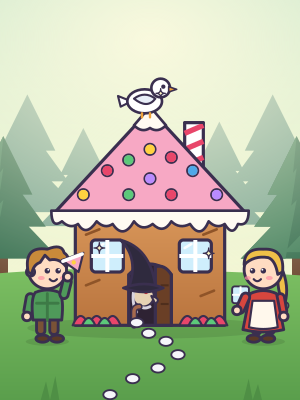
The bird led them to a little house in a clearing, and it landed on the roof. The children rubbed their eyes. The walls were made of bread, the roof was made of cake, and the windows were made of clear sugar. "Let's have a good meal!" said Hansel. He reached up and broke off a piece of the roof, and Gretel nibbled at a window.
Then a soft voice called from inside. "Nibble, nibble, like a mouse, who is nibbling at my house?" The children answered, "It's only the wind, the wild, wild wind!" and they kept on eating. Suddenly the door opened, and a very old woman hobbled out on a crutch. Hansel and Gretel were so frightened that they dropped their cake.
But the old woman only nodded and smiled. "Oh, you dear children," she said. "Come inside and stay with me." She gave them milk and pancakes with sugar, apples and nuts. Then she tucked them into two little beds with clean white sheets. Hansel and Gretel felt as if they were in heaven. They did not know that she was only pretending to be kind.
The old woman was really a wicked witch, and she had built her house of bread to trap hungry children. Witches have red eyes and cannot see far, but they have sharp noses like animals. In the morning she grabbed Hansel and shut him in a little cage with iron bars. "Cook something good for your brother," she told Gretel. "I want to fatten him up."
Every morning the witch hobbled to the cage. "Hansel, stick out your finger," she croaked, "so I can feel if you are getting fat." But clever Hansel held out a little bone instead. The witch could not see well, so she felt the bone and grumbled. "Still so thin!" Gretel cooked and scrubbed all day, and every night she thought hard about how to escape.
Part Four · Home Again
After four weeks, the witch lost her patience. "Fat or thin, I won't wait any longer," she said. She unlocked the cage and bent down to pull Hansel out. Quick as a flash, Hansel ducked under her arm, and Gretel gave the witch a mighty push. She tumbled right into the cage! Gretel slammed the door and turned the big iron key.
"Let me out!" screamed the witch, rattling the bars. But Gretel put the key in her pocket. "Now you know how it feels," she said. Then the children looked around the house. In every corner stood boxes full of pearls and shining jewels. "These are better than pebbles," laughed Hansel, and he filled his pockets. Gretel filled her apron, and off they ran.
After a long walk, they came to a wide lake with no bridge and no boat. "We can never get across," said Gretel. Then she saw a white duck swimming nearby. "Little duck, little duck, will you carry us over?" she called. The kind duck paddled up and carried them across the water, one at a time, so that it would not be too heavy.
Soon the forest began to look more and more familiar. At last they saw their own little house, and they ran to the door. Their father and mother cried with joy, because they had searched the forest every single day. Hansel emptied his pockets, and Gretel shook out her apron. Pearls and jewels rolled across the floor, and the family was never hungry again.
As for the witch, she rattled the bars of her cage for a long, long time. Some say a woodpecker finally pecked the lock open, and she hobbled off over the hills, grumbling, never to be seen again. And Hansel and Gretel? They always stuck together after that, because together they had been braver and cleverer than any witch.