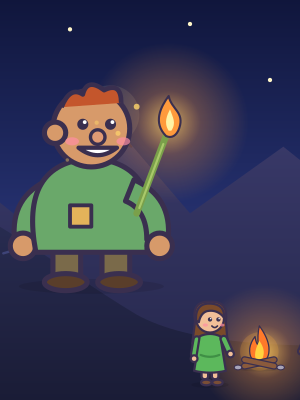
Prometheus and the Fire: the full story
Part One · Clay and Breath
Before the age of human civilization, after the tremendous war in which Zeus and the younger gods overthrew the ancient Titans and imprisoned most of them in the gloomy depths of Tartarus, there remained on earth a Titan named Prometheus, whose name signifies forethought, because he possessed the extraordinary ability to anticipate consequences long before anyone else had perceived them. During the war he had foreseen the victory of Zeus and had prudently fought on the side of the Olympians, so he was permitted to wander freely across the newly ordered world, a solitary giant among mountains and rivers that seemed curiously empty, populated by animals of every description but by no creature capable of wondering at the stars, composing a song or remembering its grandfather. The world was beautiful, but nobody was there to notice it. Prometheus found this emptiness unbearable, and he resolved to populate the silent world with companions.
Kneeling beside a river in the region that would later be called Phocis, Prometheus gathered handfuls of the reddish clay along its banks and, mixing it with water, began, with extraordinary patience and concentration, to fashion figures in the shape of the gods themselves, upright and slender, with faces turned toward the sky instead of toward the ground, like the faces of animals. His brother was called Epimetheus, whose name signifies afterthought. He had already distributed all the most useful gifts among the animals, generously and carelessly, granting claws to the lion, wings to the eagle, shells to the tortoise and thick fur to the bear, so that when Prometheus inspected his finished creations, he discovered that nothing whatsoever remained for them, neither armor nor speed nor warmth, and that they stood defenseless and trembling among the beasts. Epimetheus shrugged apologetically. It was too late to take anything back. Nothing was left for the new people.
The goddess Athena, who admired the delicacy of his workmanship, breathed spirit into the clay figures, and they opened their eyes and blinked uncomprehendingly at the world, and Prometheus loved them immediately with the protective tenderness that an inventor feels toward a fragile and imperfect invention. Over many seasons he taught them patiently and affectionately to observe the rising and setting of the constellations, so that they could calculate the seasons, and to count, and eventually to write. Yet their existence, despite all his instruction, remained desperately and incurably miserable. They lived in sunless caves like ants, they ate their food raw, and when winter descended from the northern mountains, they huddled together shivering in the darkness, and many of them perished, because the only element that could have rescued them, fire, belonged exclusively to the gods. Prometheus watched them suffer. He could not bear it, and he began to think.
Part Two · The Trick at Mecone
The relationship between gods and mortals required formal arrangement, and so a solemn assembly of gods and mortals was convened at the sacred meadow of Mecone to determine which portion of every sacrificed animal should be offered to the immortals and which portion the humans might keep for themselves. Prometheus volunteered to divide the ox, and he devised a remarkably audacious deception. Into one bundle he placed the excellent meat and the nourishing organs, wrapped deceptively inside the unappetizing stomach of the animal. Into the other he arranged the bare, inedible bones, concealed beneath a glistening and attractive layer of white fat. Then he presented both bundles to Zeus with elaborate courtesy, inviting the king of the gods to select whichever portion he preferred, and the immortals leaned forward to observe the decision. The hall fell silent. Everyone was watching Zeus. The two bundles lay side by side on the grass.
Zeus, according to some storytellers, recognized the deception immediately and chose the deceptive portion deliberately, because he desired a pretext for anger; according to others, he was genuinely deceived by the shining fat. Either way, when he lifted the glistening layer and discovered nothing beneath it except bare white bones, his fury shook the summit of Olympus. From that day forward, mortals would burn the bones and fat upon their altars for the gods and keep the nourishing meat for themselves, as Prometheus had intended. But Zeus exacted an immediate revenge upon the creatures whom the Titan so obviously favored. He decreed that fire, the most precious and powerful of all elements, would be withheld from humanity permanently. Let them eat their meat raw, he declared contemptuously, since they appreciated it so enormously. The hearths of earth went cold. Darkness returned to every cave. The people did not understand what they had done wrong.
Part Three · The Stolen Fire
Prometheus observed the consequences of this merciless decree with mounting anguish and indignation. Through the endless winter nights he watched his creatures crowding together in their caves, their children whimpering with cold, their food unprepared, their tools incapable of improvement, while predators prowled outside the entrances, invisible in the absolute darkness. He understood perfectly, with the terrible clarity of his forethought, exactly what would happen if he disobeyed the king of the gods, because Zeus had never forgiven an insult and had already demonstrated in the war against the Titans the extent of his vindictive power. Nevertheless, he concluded that the existence of the creatures he had shaped from the river clay was more important than his own security, and he resolved to steal the fire. He told no one of his plan. He simply set out alone, and he did not look back once at the caves behind him.
He traveled first, secretly and alone, to the distant island where the giant fennel grows, a plant whose tall stalks are hollow inside and filled with a dry, slow-burning pith, and he cut one stalk and carried it with him. Then, according to the oldest storytellers, he climbed secretly to the heavens and approached the blazing chariot of the sun as it descended toward the western ocean, or, according to others, he crept into the workshop of Hephaestus, the blacksmith god, where the immortal forges glowed perpetually. There, while nobody was watching, he thrust the end of the fennel stalk into the flames until a single ember caught inside the pith, smoldering invisibly within its green casing, and then he descended to earth again, concealing the stolen spark beneath his cloak like a guilty secret. Nobody saw him go, and nobody, not even the watchful gods, saw him return.
That night Prometheus gathered the shivering humans at the mouth of their largest cave, broke open the fennel stalk and blew gently upon the ember until it glowed, then fed it with dry grass and twigs until a small flame leaped upward, illuminating the astonished faces around it with flickering gold. The people recoiled in bewildered terror at first, covering their eyes against the unfamiliar brightness, and then crept closer, extending their hands cautiously toward the unfamiliar warmth. He taught them how to feed the flame and how to protect it from wind and rain, how to carry it from one hearth to another, how to roast their meat and bake their bread, how to harden the points of their spears and fire their clay into pottery, and eventually how to melt copper and tin into bronze. The children laughed in the warm light. For the first time, the long night was not frightening.
Part Four · The Rock in the Caucasus
Fire transformed everything, absolutely and permanently, in the lives of the creatures of clay. It warmed the caves and banished the predators, it prolonged the evenings, so that families sat together after sunset telling stories, and it made possible every craft and every invention that humanity would subsequently develop. The playwright Aeschylus, centuries later, imagined Prometheus declaring proudly that every art possessed by mortals had come from him: architecture and astronomy, numbers and letters, the taming of horses, the building of ships, and the healing of illnesses with medicine. Far above on Olympus, however, Zeus glanced down one evening across the darkened world and noticed, scattered across the valleys and mountainsides, thousands of tiny points of light glimmering where previously there had been only absolute darkness, and he understood instantly who was responsible. His face darkened like a storm. He did not need to ask. He already knew the answer.
His punishment was swift and pitiless. He commanded Hephaestus, with his two brutal servants Force and Violence, to seize the Titan and carry him to the remote mountains of the Caucasus, at the edge of the world, and to bind him with unbreakable chains of adamant to a rocky precipice, exposed to the scorching sun by day and to the freezing frost by night. Hephaestus obeyed reluctantly and sorrowfully, for he genuinely pitied his old friend and admired his courage, and he apologized as he hammered the rivets. Every day, moreover, an enormous eagle, the messenger of Zeus, descended upon the helpless Titan and tormented him, and because Prometheus was immortal, his wounds healed every night, so that his suffering could begin again with every sunrise, apparently without end. Still the Titan did not cry out. He only watched the horizon, and he waited, and he did not give in.
Yet Prometheus never repented, and he never begged for forgiveness. He possessed, moreover, a secret of enormous importance to Zeus himself, a prophecy concerning which marriage might someday produce a son mightier than his father, and he steadfastly and stubbornly refused to reveal it, despite every threat and every messenger the gods dispatched to the mountain. The sea nymphs came across the waves to weep in sympathy at the foot of his rock, and the Titan Oceanus visited him with sympathetic advice, urging him to submit, but Prometheus answered that he would not exchange his suffering for the servitude of obeying a tyrant. For many generations he remained chained to the precipice, gazing across the mountains toward the distant world of mortals, where the fires he had given them burned on every hearth. That sight was his comfort. It was enough to keep his heart strong through all the long years.
At last, after ages had passed, the hero Heracles, journeying eastward on one of his celebrated labors, arrived in the Caucasus and discovered the chained Titan upon his rock. With a single arrow he drove away the eagle forever, and then he shattered the adamantine chains with his tremendous strength and set Prometheus free. Zeus, who was gratified by the glory of his own son and had grown somewhat wiser with the passing of ages, permitted the liberation, and Prometheus finally revealed his secret, so that the king of the gods avoided the marriage that might have destroyed him. According to legend, Prometheus wore thereafter a ring fashioned from a link of his chain, with a fragment of the rock set within it, and humanity has kept that custom of rings ever since, in memory of the friend who gave them fire. So the story goes. And every time we light a candle, we remember him.