Sir Gawain and the Green Knight: the full story
Part One · The Christmas Game
At Camelot the Christmas festivities had continued for fifteen glorious days, with tournaments by daylight and dancing by candlelight, and on New Year's Day King Arthur sat in his great hall among the most celebrated knights in Christendom, refusing, according to his peculiar custom, to begin his dinner until somebody had told him a marvelous story or until some astonishing adventure had interrupted the feast. He did not wait for long. Scarcely had the first course been served when the doors burst open with a crash, and a gigantic horseman came riding straight into the hall, so enormous that he seemed half a giant, yet handsome and splendidly dressed. The entire company stared in silence, because the stranger and his horse were green, astonishingly green, from the crown of his head to the hooves of his tremendous charger, as green as grass in the spring.
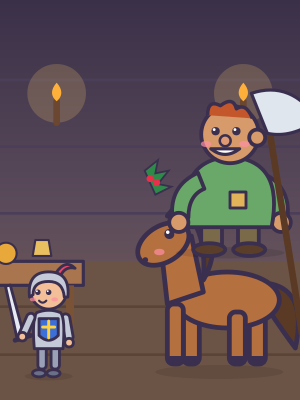
His hair hung around his shoulders like a cape, his beard spread across his chest like a bush, and his clothing was embroidered with green silk and decorated with emeralds. He carried no helmet, no shield and no armor, but in one hand he held a branch of holly, which is greenest when the forests are bare, and in the other an immense axe, its blade a full yard wide, polished like a mirror. He rode the length of the hall without greeting anyone, surveyed the knights with an expression of disdainful amusement, and inquired in a thunderous voice which of them was the governor of this gathering. When Arthur courteously identified himself and invited him to dismount and dine, the Green Knight declined, explaining that he had come neither to feast nor to fight, but to propose a Christmas game.
The terms of his game were simple and appalling. Any knight in the hall who possessed sufficient courage might take the great axe and strike the Green Knight a single blow, wherever he pleased, and the Green Knight would receive it without resistance, on the sole condition that, in a year and a day, the challenger would seek him out and accept an identical blow in return. The knights sat paralyzed with astonishment, and the silence stretched uncomfortably until the stranger burst into scornful laughter, mocking the famous Round Table, whose reputation, he declared, had evidently been exaggerated. Arthur, flushing with anger, sprang up to accept the challenge himself, but his young nephew Gawain rose from his seat and begged respectfully that the adventure be granted to him, since his own life, he said modestly, was the least valuable at the table.
The king consented, and Gawain took the gigantic axe. The Green Knight dismounted, bowed his head, swept his long hair forward to expose his neck, and waited calmly, as though he were expecting nothing more alarming than a haircut. Gawain raised the axe and brought it down with all his strength. Then something happened. What followed was so uncanny that the company remembered it for the rest of their lives. Instead of collapsing, the Green Knight simply stooped, picked up his own head from the floor where it had rolled, and climbed back into his saddle, holding it by the hair. Then the head opened its eyes, looked directly at Gawain, and reminded him of his promise. He must present himself, a year from that day, at the Green Chapel, where the Green Knight would repay the blow. With that, the horseman galloped out of the hall, and nobody saw where he went.
Part Two · The Winter Journey
The seasons passed with alarming rapidity, as they always do when something dreadful awaits at the end of them. Winter dissolved into the soft rains of spring, summer ripened into the golden fields of harvest, and when the autumn winds began stripping the leaves from the trees, Gawain prepared for his departure. On All Saints' Day he armed himself in gleaming armor and mounted his horse Gringolet, carrying a shield painted with a golden pentangle, the five-pointed star that symbolized the five virtues of a perfect knight: generosity, fellowship, purity, courtesy and compassion. The entire court accompanied him to the gates, lamenting that so admirable a young man should be sacrificed to a monstrous Christmas game, and Gawain rode northward alone into the wilderness, with no idea where the Green Chapel might be found, nor whether he would ever see Camelot again.
His journey through the northern wilderness was long and exhausting. He traveled through desolate forests and across icy rivers, inquiring at every settlement about the Green Chapel, and nobody had ever heard of it. He was obliged to fight wolves and wild boars, and occasionally, according to the poet, dragons and troublesome giants who lived among the crags, but the cold was more dangerous than any enemy. He slept in his armor on frozen rocks, while freezing rain fell from the clouds and icicles hung above his head. On Christmas Eve, miserable and lost in a dense forest of oaks, he prayed earnestly for shelter, and when he looked up, he beheld through the trees a magnificent castle, shining with towers and pinnacles, standing in a meadow beyond a deep moat, its windows glowing warmly through the falling snow like a promise of rescue.
Part Three · The Exchange of Winnings
The lord of the castle, a broad and cheerful man with a beard the color of a beaver, welcomed Gawain with extravagant hospitality, introduced him to his beautiful wife and to an elderly lady wrapped in silks, and assured him, to his enormous relief, that the Green Chapel was scarcely two miles away. Gawain could therefore remain as his guest until New Year's morning. Then the host proposed an entertaining arrangement. For the three days before the New Year, he would go hunting from dawn until dusk while Gawain rested in the castle, and every evening the two of them would exchange whatever they had won during the day. It sounded like harmless fun. Gawain, amused and grateful, agreed, and the bargain was sealed with a cup of wine beside the roaring fire, while the household laughed and applauded the agreement.
Each morning the lord departed before sunrise with his hounds and his huntsmen, and each morning, while Gawain lay in bed, the lord's wife came quietly into his chamber, sat beside him and attempted, with charming and persistent conversation, to win his affection. Gawain answered every compliment with impeccable courtesy, refusing to dishonor his host, and he accepted from her nothing more than a polite kiss on the cheek, given in friendship when she departed. On the first evening the lord returned with a deer and presented it to Gawain, who gave his host a kiss on the cheek in exchange, declining to explain where he had obtained it. On the second evening the lord brought home a wild boar, and Gawain repaid him with two kisses, and both men laughed heartily at the bargain, without either of them asking the other any embarrassing questions.
On the third morning the lady made her final attempt, and when Gawain again declined her affection, she offered him a gift to remember her by. He refused a precious gold ring, but then she unfastened from her waist a girdle of green silk, embroidered with gold, and explained in a whisper that whoever wore it could never be killed by any means on earth. Gawain hesitated. He was afraid. He thought of the Green Chapel and the gigantic axe, and his courage faltered, and he accepted the girdle, promising to conceal it from her husband. That evening the lord returned with nothing but the skin of a fox, and Gawain gave him three kisses, but he said nothing whatever about the green girdle, which lay hidden beneath his clothing, against his heart, like a secret that grew heavier with every passing hour.
Part Four · The Green Chapel
New Year's morning arrived with a raging snowstorm. The wind howled. Gawain armed himself, secretly fastening the green girdle around his waist, and a servant guided him through the frozen hills to the edge of a desolate valley, where he left him, advising him earnestly to flee while he still could, and promising never to reveal his cowardice. Gawain refused. He rode down alone. At the bottom of the valley, beside a churning stream, he discovered a grassy mound with holes at either end, hollow inside, overgrown with weeds, more like a grave than a chapel. Then, from somewhere above the rocks, came a horrible grinding noise, like a scythe being sharpened on a whetstone, and the Green Knight appeared, striding across the stream with a brand new axe, as gigantic and as green as he had been a year before.
Gawain bared his neck. He bowed his head and waited. The Green Knight raised the axe high, and as it descended, Gawain flinched, ever so slightly, and the Knight halted the blow and mocked him, remarking that he himself had never flinched in Arthur's hall. Ashamed, Gawain promised to remain motionless, and the Knight raised the axe a second time and stopped again, deliberately, only to test his nerve. Furious now, Gawain demanded that he strike and finish the matter. The third time, the axe came down in earnest, but it merely grazed the side of Gawain's neck, leaving the smallest of nicks. Seeing a drop of crimson on the snow, Gawain sprang away, drew his sword, and declared that the bargain had been fulfilled, and that any further blow would be answered with steel, according to the rules of their agreement.
The Green Knight leaned upon his axe and regarded him with unexpected warmth, and then he revealed the truth. He was the lord of the castle, Bertilak, transformed by the enchantments of the elderly lady, who was none other than the sorceress Morgan le Fay, and the entire adventure had been designed to test the honor of Arthur's court. The first two feints, he explained, were for the first two days, when Gawain had faithfully returned everything he received. The nick on his neck was for the third day, for the green girdle he had concealed. "You failed only a little," said the Knight kindly, "and only because you loved your life, and I cannot blame you for that." He invited Gawain to keep the girdle, as a souvenir of the adventure, and to return to the castle to celebrate the New Year.
Gawain, however, was consumed with shame, and he cursed his own cowardice and covetousness, insisting that the girdle would remain forever a reminder of his failure. He rode back to Camelot through the winter wilderness, the green silk wrapped across his body like a sash, and when he arrived he confessed everything to the king and the assembled knights, sparing himself nothing, blushing as he described the hidden girdle and the nick on his neck. The hall was silent. But the court did not condemn him in the slightest. Instead, the king and every knight of the Round Table agreed to wear a green sash in Gawain's honor, as a sign that the bravest and most honest of men may falter, and that honor lies not in being perfect, but in admitting one's faults honestly, learning from them patiently and becoming better.