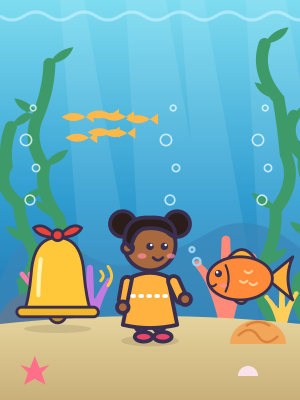
The Deep End of Carrowglen: the full story
Part One
Kit Alder had not been in the deep end since the day she failed her swimming test, and she was not planning to start on a Saturday when the pool was shut. The big doors were chained, and a notice said CLOSED FOR REPAIRS in letters as flat as a slap. But Mom was inside mopping the changing rooms, and the side gate had been left open, and Rory, who was eight and never waited for anything, had already run down the tiles to the deep end. He stood looking at the ladder with his shoes still on.
"It has more rungs than it should," said Rory. Kit came up beside him and looked. The water in the deep end was very dark and very still, like a window at night, and the ladder went down into it, rung after rung after rung, far beyond the place where the bottom should have been. "That is not possible," she said, "because it is only a pool." But Rory had already swung his legs over the rail. "Back in a minute," he said, and went down the ladder like somebody climbing into a loft, and the dark water closed over his head without a sound.
Kit waited. She counted to twenty, slowly, because counting was what she did instead of panicking, and Rory did not come up, so she counted to forty. Her heart was hammering in her ears, and her hands had gone cold, and everything inside her insisted that an eleven-year-old who has failed a swimming test does not climb into deep water. Then she thought about Rory's wet shoes sinking, and she took off her own, very neatly, and put them side by side. She took one big breath, held it, and went down the ladder after him.
The water was not cold, which was the first strange thing. The second was that after the thirteenth rung her feet found a floor, and she let out her breath in a rush, expecting to choke, and found that she could breathe. It was slow and heavy, like breathing inside a bell, but it was air of a kind. She was standing at the end of a cobbled street. Lamps glowed along it in pale gold, and houses leaned together with their doors open, and above the roofs the surface shimmered like a ceiling made of light. Rory was sitting on a step, swinging his legs, and he said, "I told you."
Part Two
"Name's Gull," said the bird on the lamp-post. He was a real gull, gray and white, with a bright yellow beak and an expression of deep suspicion, and he talked in a rough, quick voice like an old sailor. "Guide. I take the fee in chips, hot and salted, in paper, and don't look at me like that, because I have bills." "We do not have any chips," said Kit. "Then you owe me chips," said Gull, "and I will be keeping count." He hopped down onto Rory's shoulder, where he settled as if he had been born there. "Welcome to Carrowglen, and stay on the cobbles, and mind the Tide."
Carrowglen was a town, Gull explained as they walked, and a hundred years ago it had stood in a green glen with a river running through it. Then the engineers came to build a great dam, and the river rose, and the glen filled with water and became a reservoir. The families packed their carts and moved away to higher ground, and the whole town sank. "But water remembers," said Gull. "It held the town just as it was, every street and every lamp, so the place never quite disappeared. It only went down, and someone stayed behind to keep it."
The someone was the Queen, and they found her in the town hall, in a high room with a tall window and a table of drifting papers. Queen Ione was very tall and very old. Her gown was woven of green water-weed, and her crown was made of tiny shells, and she looked at the children as if they had come a long way to bring her bad news. "I do not know my name," she said gently. "I have been looking for it a long time, and each time I forget a little more, the lamps go out. Soon there will be no Carrowglen, and I shall not know what I have lost."
"Three things are gone," said Queen Ione, "and I think my name is bound up with them. The bell that rang the hours, which was taken from the church tower. The key to the town hall clock, which stopped on the day the water came. And the plate from this door, which had my name on it, and which fell into the Deep." She put a thin hand on Kit's arm, and it was as light as a leaf. "Find them, and the way home will open, as it opened for you. And hurry, for the Tide is coming."
Part Three
The Tide arrived while they were still on the stairs. First the lamps leaned, all one way, as if a wind had gone through them, and then the street began to slide. A slow cold pull came up from the far end of the glen, steady and enormous, and it tugged at doors and shop signs and the hems of their coats. Kit grabbed a railing with one hand and Rory with the other, and Gull swore in gull. Then it was gone, as quickly as it had come. At the bottom of the street, a whole baker's shop had vanished, and only a clean pale square of cobbles showed where it had been.
"Every hour," said Gull grimly, "a little more of the town goes, and that is why you have to be quick." The church tower stood at the top of the hill, and the bell hung in the dark at the very top, under the roof, with a rope that dangled a long way out of reach. Rory started to climb the outside of the tower, handhold by handhold, because he had never in his life thought of falling, and Gull flew circles about his head. Kit stood at the bottom and held the rope end and said every careful thing she could think of, which was a great many, and Rory ignored all of them.
The bell was green with a hundred years of weed, and when Rory pulled the rope, it gave a tiny, flat clank. "Harder," called Kit, and he hung his whole weight on it, and the bell spoke at last. It was a huge, clear, golden note, and it went out over Carrowglen like a hand opening. Every lamp in the town flared. Doors that had been shut for a century swung wide. From a long way off, as the sound died away, the Tide gave a low, uneasy moan, and Kit had the strangest feeling that something enormous had stopped to listen.
The clock key was in the library cellar, and the cellar was dark. Nobody had told Kit that the worst part of being the careful one is that you are the one who goes first into the dark. She took Rory's little keychain flashlight, and she went down the stairs with her heart knocking, and she found the key where it had slid between two shelves, black with age and cold as a stone. When she held it up, it began to glow a faint blue. "Good," whispered Gull, from somewhere above her head. "Now the last one, and that one, I am afraid, is in the Deep."
The Deep was a great round trench at the edge of the town where the ground simply dropped away into green darkness. Kit stood on the edge with the key in her fist. Her hands would not open, and the dark below was green and still. This was the deep end she had not entered since the test, and it was a hundred times deeper, and the plate lay somewhere down there. "I will go," said Rory, "because you do not have to." "I know," said Kit. She sat on the edge, very slowly, with her legs over the dark. She counted to three, and she slid in, and the water took her down.
It was not a long way, in the end. The brass plate lay on the trench floor in a ring of silver light, and Kit picked it up, and rubbed it on her sleeve, and read out loud what was written there. IONE ARDEN, KEEPER OF CARROWGLEN. And the Tide came. It rose out of the darkness all around her like a wall of slow green glass, and for a moment she was very small, and very frightened, and entirely unable to move, and then it spoke. "Please," it said, in a voice as deep as the sea, "I am so tired, and I only want to go home."
Part Four
It was not an enemy after all. Kit knew that at once, the way you know a person is crying before you see their face. The Tide was the old river, tired out, and all it wanted was to go on to the sea, the way every river in the world does, without anybody holding it back. Every hour it had tugged a little more, hoping that someone would notice. "I cannot let go while she forgets," said the Tide, "and if nobody remembers Carrowglen, it will drown a second time."
Kit climbed out of the Deep with the plate in one hand and the key in the other, and she went straight to the town hall, with Rory at her side and the Tide humming behind her. In the high room, the Queen was sitting very still. Kit set the plate in her hands and said, "Ione Arden, and that is you." The Queen looked at the plate for a long time. Then she stood up, taller than before, and the shells in her crown rang, and she said, "Yes. Yes, I was the keeper, and I am glad you found me."
"The Tide may go," said Ione Arden, "if the town is remembered by those above." She looked at the two of them with eyes like deep green glass. "Will you remember?" "We will tell people," said Rory at once, "we will tell everybody." "A bell can be heard even when the town cannot be seen," said Kit slowly, and she picked up the clock key and wound the great clock, and it began, after a hundred years, to tick. And the Tide, with a long sigh like a door finally opening, began to move.
Gull took them back to the ladder, and he was still talking about chips. The water was drawing out of the glen in one wide, gentle current as they walked, and the lamps grew dim, one by one, and each one went out as if it had been put to bed. At the bottom rung, Kit turned around. For one moment she saw the whole town, every roof and chimney, shining below her like something carried very carefully in cupped hands. Then she put her foot on the first rung, and Rory beside her, and they climbed up into the afternoon.
The next summer, when the pool reopened, there was a small brass plate on the tiles by the deep end. Kit had written the words herself, and the town council had thought them very odd, and had put them up anyway. CARROWGLEN, it said. UNDER THE RESERVOIR SINCE 1926. ASK ABOUT THE BELL. Rory had found a tiny green bell in his coat pocket that morning, which did not ring when he shook it, and which he put on the poolside bench. At the edge of the deep end, with her toes curled over the tiles, Kit took one breath, and listened to the water, and dived.