The Emperor's New Clothes: the full story
Part One · The Magic Cloth
Many years ago there lived an Emperor who loved new clothes more than anything in the world. He did not care about his soldiers or his people, and he never went to the theater, unless it was a chance to show off a new coat. He had a different outfit for every hour of the day. When people asked where he was, his servants said, "The Emperor is in his dressing room."
One day, two tricksters came to the city. They told everyone they were weavers, and that they could weave the most beautiful cloth anyone could imagine. "The colors and patterns are marvelous," they said, "but our cloth is magic. Anyone who is foolish, or who is not good at his job, cannot see it at all. To him, it is completely invisible."
"What wonderful cloth!" thought the Emperor. "If I wore clothes made of it, I could find out which of my men are not fit for their jobs. I could tell the clever ones from the fools!" So he paid the two weavers a big bag of gold to start at once. They set up two looms and pretended to work, but there was nothing on the looms at all.
The tricksters asked for the finest silk and the purest gold thread. They stuffed it all into their own bags, and then they went on working at the empty looms until late at night. "I wonder how they are getting on," thought the Emperor. But he felt a little uneasy. What if he could not see the cloth himself? He decided to send someone else first.
Part Two · Nothing on the Looms
He sent his honest old minister, who was very wise. The old man went into the room and stared at the empty looms. "Goodness!" he thought, and his eyes opened wide. "I cannot see anything at all!" But he did not say so. "Come closer," said the tricksters. "Is it not a lovely pattern? Are the colors not bright?"
The poor old minister stared and stared, but he could not see anything, because there was nothing to see. "Am I a fool?" he thought. "Am I not fit for my job? Nobody must ever know!" So he said, "Oh, it is charming! I shall tell the Emperor how much I like it." The tricksters were delighted, and they described every color and pattern so he could repeat it.
Soon the Emperor sent another official, and the same thing happened. He looked and looked, but there was only the empty loom. "I am not foolish," he thought, "so it must be my job I am not good at. Nobody must find out!" He praised the cloth he could not see, and he told the Emperor it was magnificent. Soon the whole city was talking about the marvelous cloth.
At last the Emperor went to see it himself, with all his ministers. The tricksters were weaving busily, without a single thread. "Is it not magnificent?" said the two officials, pointing at nothing. "Whatever is this?" thought the Emperor. "I see nothing at all! Am I a fool? Am I not fit to be Emperor?" Out loud he said, "Oh, it is very pretty! It has my highest approval."
Part Three · Getting Dressed
The night before the great parade, the tricksters stayed up with sixteen candles burning. They pretended to take the cloth off the looms. They cut the air with big scissors, and they sewed with needles that had no thread. They worked so hard that they were yawning by morning. At last they said, "Look, now the Emperor's new clothes are ready!"
In the morning the Emperor came, and the tricksters held up their arms as if they were holding something. "Here are the trousers, here is the coat, and here is the cloak," they said. "They are as light as a spider's web. You might think you had nothing on, but that is the beauty of it." "Yes, indeed," said all the ministers, though none of them could see a thing.
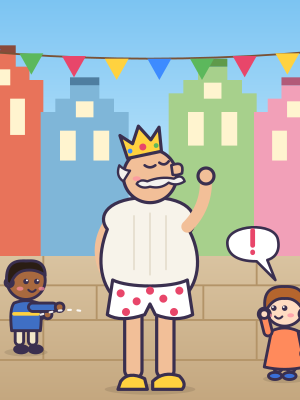
"If Your Majesty will kindly take off your clothes," said the tricksters, "we will help you into your new ones, here in front of the big mirror." So the Emperor undressed down to his spotted underwear, and they pretended to put on each new piece. The Emperor turned and twisted in front of the mirror. "How well it fits!" everyone cried. "What a perfect pattern!"
Two servants were meant to carry his long train. They bent down and pretended to pick it up, and they walked along holding their hands in the air. They did not dare let anyone know that they could not see anything. Then the Emperor marched out under a golden canopy, and the great parade began.
Part Four · The Parade
All the people in the streets and at the windows cried, "Oh, how fine the Emperor's new clothes are! What a beautiful train!" Nobody wanted anyone to think that he was a fool. None of the Emperor's clothes had ever been such a great success. And the Emperor marched along in his crown and his spotted underwear, holding his nose in the air.
Then a little child in the crowd tugged on her father's sleeve. "But he hasn't got anything on!" she said. "Just his underwear!" "Listen to the innocent child," said her father. The people near them began to whisper, and the whisper went from one person to the next. "He hasn't got anything on! A little child says he hasn't got anything on!"
"He hasn't got anything on!" cried the whole town at last. The Emperor shivered, because he suspected they were right. But he thought, "The parade must go on." So he walked along more proudly than ever, and the servants held up the train that was not there. As for the two tricksters, they had sneaked out of town that morning with all the gold and silk.